Concrete compressive strength testing is one of the most important quality-control tests performed by construction-material laboratories, ready-mix concrete producers, precast manufacturers, contractors, universities, and research organizations.
Choosing the right concrete compression testing machine in Canada requires more than comparing maximum load capacity. Laboratories should consider machine stiffness, load accuracy, loading-rate control, specimen dimensions, automation, data acquisition, calibration, safety, electrical requirements, after-sales support, and compatibility with applicable testing standards.
This guide compares 10 notable concrete compression testing machine options for Canadian laboratories in 2026, including Canadian-manufactured equipment and established international systems available to the Canadian market.
Quick answer: For many Canadian concrete laboratories, a 2000 kN automatic concrete compression testing machine provides an excellent balance between capacity, specimen compatibility, automation, laboratory productivity, and cost. Canadian-manufactured options such as the CANTROL Fully Automatic Welded Frame Concrete Compression Machine are particularly attractive when local engineering, customization, and Canadian support are priorities. (Cantrol)
| Rank | Manufacturer / Machine | Capacity | Automation | Best For |
|---|---|---|---|---|
| 1 | CANTROL Fully Automatic Welded Frame | 1200–3000 kN | Fully automatic | Canadian laboratories & QC |
| 2 | Forney Compression Machines | Various | Manual/automatic/connected | High-volume concrete testing |
| 3 | CONTROLS AUTOMAX PRO-M | Up to 3000 kN | Automatic | Advanced connected laboratories |
| 4 | CONTROLS PILOT PRO | 2000–3000 kN | Automatic | QC laboratories |
| 5 | Humboldt HCM Series | Up to 6000 kN | Automatic/servo | High-strength & UHPC |
| 6 | ELE ADR Series | Up to 3000 kN | Automatic | Concrete, cement & mortar |
| 7 | Matest 2000 kN Series | 2000 kN | Manual to automatic | Production & laboratory testing |
| 8 | Tinius Olsen SL Series | Various | Digital/automatic options | Research & advanced materials |
| 9 | CANTROL Semi/Automatic Cement-Mortar Machine | 600 kN | Semi/automatic | Cement & mortar |
| 10 | CANTROL Universal Testing Machine | Up to 1200 kN compression | Digital | Combined tensile/compression testing |
Rankings are a practical buyer’s-guide ranking, not an independent laboratory performance test. Availability, configuration and Canadian distribution should be confirmed with the manufacturer or supplier.
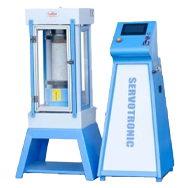
The CANTROL Fully Automatic Welded Frame Concrete Compression Machine is designed and manufactured in Canada and is available in 1200, 1500, 2000 and 3000 kN configurations. The machines are designed for concrete laboratories, ready-mix plants, QA/QC facilities, universities and research laboratories. (Cantrol)
The system uses a rigid welded-steel frame and a touchscreen control system. The available configurations use a 7-inch full-colour touchscreen, 1 kN resolution, USB communication, USB data storage and internal storage for up to 500 test results. (Cantrol)
CANTROL also offers configurations compatible with 120 V, 60 Hz, single-phase power, which is particularly convenient for Canadian laboratories. (Cantrol)
For a Canadian laboratory purchasing a new machine, CANTROL has an important advantage: local Canadian manufacturing and engineering support.
Best choice for: Canadian construction laboratories, ready-mix companies, universities and QA/QC facilities looking for a fully automatic 2000 or 3000 kN system.
View the CANTROL Fully Automatic Concrete Compressi Machine
Forney is a well-established manufacturer of construction-material testing equipment and offers a broad range of compression machines.
Its compression systems can test concrete cylinders, cubes, blocks, beams and prisms, with manual, automatic and connected-control configurations. Forney lists compatibility with standards including ASTM C39, C78, C109, C140, C469, C496, AASHTO T22 and EN 12390-3. (Forney Online)
Forney also offers high-stiffness FHS-series machines for demanding testing environments. (Forney Online Learning)
Best choice for: Established laboratories wanting a broad testing ecosystem and multiple automation options.
Forney Compression Testing Machines
The CONTROLS AUTOMAX PRO-M is a high-end automatic compression testing platform intended for standard failure tests as well as advanced concrete mechanical-property testing.
The system can integrate ancillary measurement equipment and is designed around connected data management. Configurations are available at 3000 kN, including systems for cylinders and advanced tests such as elastic modulus determination. (Controls Group)
Best choice for: High-end laboratories that need advanced automation and connected test-data workflows.
The CONTROLS PILOT PRO is aimed more directly at general-purpose automatic compression testing.
The platform is available in 2000 and 3000 kN configurations, with a touchscreen interface, high-speed data acquisition, Ethernet connectivity, USB storage and automatic test functions. (Controls Group)
Its 3000 kN model can accommodate cylinders up to 160 × 320 mm and cubes up to 200 mm, depending on configuration and accessories. (Controls Group)
Best choice for: Commercial concrete-testing laboratories requiring automatic routine testing.
Humboldt offers a particularly broad range of concrete compression testing machines.
Its high-performance series includes 3000, 4000, 5000 and 6000 kN machines. Humboldt specifically identifies these systems for normal concrete as well as ultra-high-performance concrete (UHPC). (Humboldt Mfg.)
For example, the HCM-3100 is a 3000 kN servo-controlled machine, while the HCM-4100 provides 4000 kN capacity. The range extends to 6000 kN. (Humboldt Mfg.)
Humboldt also offers combined compression/flexural equipment capable of 3000 kN compression and 150 kN flexural testing. (Humboldt Mfg.)
Best choice for: UHPC research, high-strength concrete, major laboratories and high-capacity structural-material testing.
Humboldt Concrete Compression Machines
ELE International manufactures a comprehensive range of concrete-testing equipment, including compression machines for concrete, cement and mortar.
Its systems are intended for testing cubes, cylinders, beams and other specimens, with manual and automatic configurations. ELE describes its compression machines as suitable for routine testing at laboratories and construction-material facilities. (Ele.com)
ELE’s dual-frame systems can combine different compression capacities under one control console. Its listed configurations include 2000/250 kN and 3000/250 kN systems. (Ele.com)
Best choice for: Laboratories requiring a broad concrete, cement and mortar testing portfolio.
ELE International Concrete Testing Equipment
Matest offers several 2000 kN concrete compression machines, making this capacity particularly relevant for laboratories looking for a mid-to-high-capacity machine.
The range includes manual, semi-automatic and automatic configurations, including Autotec, Cyber-Plus Progress and Servo-Plus Progress versions. Matest states that the machines can test cylinders up to 160 × 320 mm and cubes up to 150 mm, depending on configuration. (Matest)
Its EN-standard high-stability machines use heavy-duty four-column frames and Class 1 calibration. (Matest)
Best choice for: Laboratories looking for multiple automation levels around the 2000 kN capacity.
Matest 2000 kN Compression Machines
Tinius Olsen’s SL range includes compression-only hydraulic testing frames designed for applications requiring controlled loading.
The company describes the SL systems as suitable for constant-speed, stress-rate and strain-rate control, with digital, wireless and software-based interface options. The systems can also be configured with compression extensometers for concrete, rock and asphalt applications. (Tinius Olsen)
Best choice for: Research laboratories and facilities performing more advanced mechanical-property testing in addition to routine compressive strength.
Tinius Olsen SL Compression Machines
Not every laboratory needs a 2000 or 3000 kN concrete machine.
For cement and mortar testing, CANTROL offers a 600 kN automatic/semi-automatic compression machine with a 7-inch digital touchscreen, software calibration and 1 kN resolution. The manufacturer lists standards including ASTM C109/C109M, ASTM C39, ASTM C307, EN 196-1 and ISO 679. (Cantrol)
This can be a practical option for laboratories whose main requirement is cement or mortar compressive strength rather than large concrete cylinders.
Best choice for: Cement laboratories, mortar testing and lower-capacity construction-material laboratories.
CANTROL Cement/Mortar Compression Machine
A universal testing machine can be attractive when a laboratory wants to perform multiple mechanical tests using one platform.
CANTROL’s CST-600 Universal Testing Machine is designed for both tensile testing of reinforcing steel and compression testing of concrete specimens. The published configuration provides 600 kN tensile capacity and 1200 kN compression capacity, with compatibility listed for standards including ASTM C39, AASHTO T22, BS 1610 and E4. (Cantrol)
Best choice for: Laboratories that need both concrete compression and steel tensile testing.
Buying the largest machine available is not necessarily the best strategy.
The correct machine depends on the specimens you test, concrete strength, testing standards, laboratory throughput and future requirements.
Common capacities include:
For general concrete-cylinder testing, 2000 kN is often a very practical capacity.
A 3000 kN machine becomes more attractive when the laboratory works with high-strength concrete, large specimens or wants greater capacity margin.
For UHPC and specialized research, 4000–6000 kN machines may be justified.
For Canadian laboratories working with concrete cylinders, ASTM C39/C39M is one of the most important standards to consider.
The machine should provide appropriate:
CANTROL’s selection guide specifically identifies compression testing machines, concrete cylinder molds and specimen-end preparation as part of the equipment required for compressive-strength testing, with ASTM C39 and EN 12390 identified as relevant standards. (Cantrol)
Manual machines can be appropriate for:
Semi-automatic systems provide a useful compromise between operator involvement and automated load control.
Fully automatic machines are generally preferable for:
Automation can improve consistency by controlling the loading process and reducing operator-dependent variation.
A compression testing machine should not be evaluated only by its maximum load.
Frame stiffness is critical.
During a high-load concrete compression test, the machine frame experiences significant forces. A rigid frame helps maintain alignment and minimizes unwanted deformation.
This is one reason several manufacturers emphasize welded or heavy four-column frames in their high-capacity systems. CANTROL, Forney, Humboldt and Matest all emphasize rigid/heavy-duty frame construction in their respective systems. (Cantrol)
The compression machine is only one part of the testing system.
Accurate compressive-strength results also depend on:
For example, CANTROL offers an automatic concrete specimen end grinder designed to produce flat cylinder ends for compression testing. (Cantrol)
A laboratory purchasing a compression machine should therefore evaluate the complete testing workflow, rather than purchasing the frame alone.
This is one of the most common purchasing decisions.
| Factor | 2000 kN | 3000 kN |
|---|---|---|
| Routine concrete | Excellent | Excellent |
| Standard cylinders | Excellent | Excellent |
| High-strength concrete | Very good | Excellent |
| UHPC | Depends on strength/specimen | Better |
| Laboratory footprint | Generally smaller | Generally larger |
| Purchase cost | Lower | Higher |
| Capacity margin | Good | Excellent |
| High-volume commercial lab | Excellent | Excellent |
For a typical Canadian construction-material laboratory, I would start with 2000 kN unless there is a clear requirement for higher capacity.
For laboratories testing high-strength concrete, UHPC, large specimens or performing research, 3000 kN or greater may be the better long-term investment.
Before requesting a quotation, ask the supplier for the following information:
For Canadian laboratories, buying a locally engineered or manufactured machine can offer advantages beyond the initial purchase price.
These may include:
This is particularly relevant for laboratories where downtime can be expensive.
CANTROL’s compression-machine range is explicitly described as engineered and manufactured in Canada, with configurations designed for Canadian 120 V/60 Hz power. (Cantrol)
There is no single machine that is best for every laboratory. For many Canadian concrete-testing applications, a 2000 kN automatic machine is a strong general-purpose choice. CANTROL, Forney, CONTROLS, Humboldt, ELE and Matest all offer systems worth evaluating.
For routine concrete-cylinder testing, 2000 kN is often a practical choice. A 3000 kN machine provides additional capacity for higher-strength concrete and more demanding applications.
ASTM C39/C39M is a major standard for compressive-strength testing of cylindrical concrete specimens. Other applicable standards depend on the specimen type and jurisdiction.
For laboratories performing frequent tests, automatic machines generally provide better workflow consistency, controlled loading and easier data recording. Manual machines can still be appropriate for low-volume or budget-sensitive applications.
The principal difference is maximum load capacity. A 3000 kN machine provides a larger capacity margin and may be preferable for high-strength concrete and specialized testing, while 2000 kN is often sufficient for routine concrete testing.
Yes. Many compression machines can be configured with appropriate platens and spacers for both concrete cubes and cylinders. The allowable specimen dimensions depend on the machine and accessories.
Calibration is critical. A compression machine must provide reliable force measurement within the accuracy requirements of the applicable testing standard and laboratory quality system.
For most Canadian laboratories, I would divide the market into four categories:
CANTROL Fully Automatic Welded Frame — 2000 kN
Best combination of Canadian manufacturing, automation, capacity and laboratory functionality.
Forney automatic/connected compression machines
A strong choice where established equipment infrastructure and technical support are important.
Humboldt 3000–6000 kN high-performance machines
Particularly attractive for UHPC and high-capacity research applications.
CONTROLS AUTOMAX PRO-M
A strong choice for laboratories emphasizing automation, connectivity and advanced concrete mechanical testing.
CANTROL is a Canadian manufacturer and supplier of construction-material testing equipment, including concrete compression testing machines, cement and mortar compression machines, specimen preparation equipment and other laboratory testing systems.
Its fully automatic welded-frame concrete compression machine is available from 1200 to 3000 kN, including a 2000 kN configuration, with touchscreen control, data storage, USB connectivity and software. (Cantrol)
For Canadian laboratories looking for a locally manufactured alternative to imported compression-testing systems, CANTROL is therefore worth including in the equipment-selection process.


